 Seyare
Proxy strategies for marketers solve the problem of biased SEO data, enabling teams to collect accurate rankings, verify ads, and analyze competitors without personalization and geo-distortion. Search engines personalize results by location, device, and browsing history — two marketers searching for the same keyword see completely different realities. E-commerce platforms change pricing by region, and ad platforms show different creatives to different segments. Proxies let you view the internet from multiple perspectives: instead of “What does Google show me?” the question becomes “What do my customers actually see?” With proxies, you get real rankings across regions, local competitor visibility, correct ad verification, and access to content across markets. Residential proxies deliver maximum accuracy, datacenter proxies handle bulk collection, mobile proxies test mobile SERPs. This guide covers how proxy strategies eliminate data distortion, improve marketing decisions, and which proxy types work best for each use case.
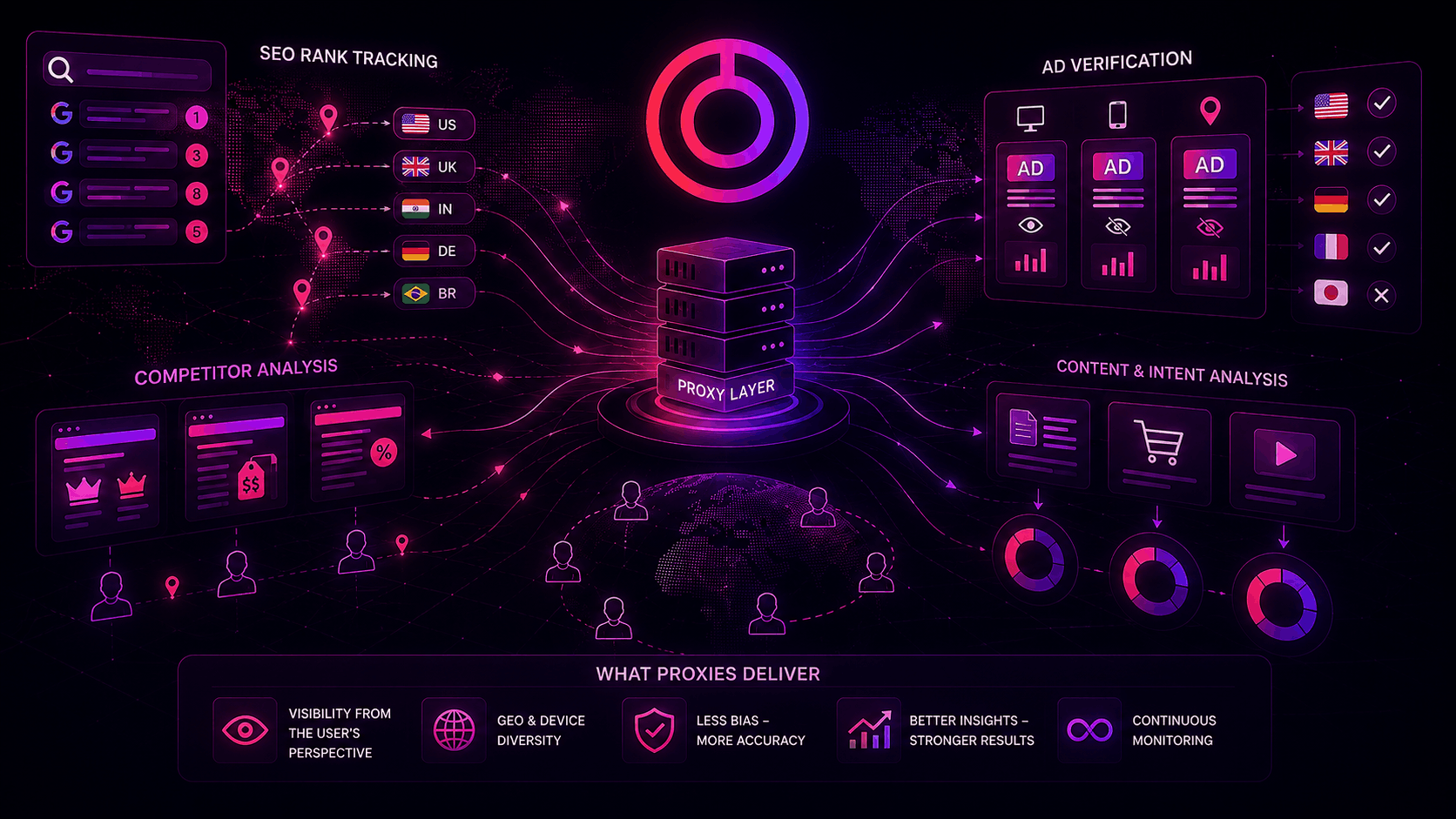
Proxy strategies provide a solution by letting teams observe the web from multiple perspectives. They are more than just tools for automation; they help broaden understanding and reduce bias in decision-making. Instead of asking “What does Google show me?” marketers can ask “What does Google show my customers?” This subtle shift transforms data collection from a mechanical task into a thoughtful, analytical process.
Understanding the Value of Proxies in Marketing
A proxy allows a marketer to route requests through different IP addresses, simulating the perspective of users in various regions or on different devices. This ability changes the way data is collected, validated, and interpreted. The most important insight here is that data without context can be misleading. By introducing multiple perspectives, proxies allow teams to capture a more accurate picture of search rankings, competitor behavior, ad visibility, and user experience.
Proxy Types and Marketing Insights
| Proxy Type | Strengths | Limitations | Practical Insight |
|---|---|---|---|
| Data Center Proxies | High speed, cost-effective, scalable | Easier to detect as automated traffic | Good for large-scale scraping, but may distort SERP data |
| Residential Proxies | Appears as real users, location flexibility | Slower and more expensive | Ideal for accurate SEO monitoring and geo-specific checks |
| Mobile Proxies | Realistic mobile behavior, carrier-level IPs | Costly and limited bandwidth | Useful for testing mobile search and localized campaigns |
This table helps marketers understand that the choice of proxy is not just technical; it directly affects the quality of insights and the reliability of marketing decisions.
Seeing SEO Rankings Through Multiple Lenses
Many teams assume that the rank they see for a keyword is universal, but in reality, rankings vary depending on location, language, and device type. Proxies allow marketers to check how search results appear to users across different regions and on multiple devices. This is essential for SEO tools and accurate rank tracking. This ensures that strategies are based on actual visibility rather than a narrow, office-centered viewpoint. For agencies managing international clients, this difference can dramatically affect performance insights and campaign decisions.
Monitoring Competitors More Effectively
Competitor analysis is often conducted from a single perspective, which leaves blind spots. Regional variations, localized offers, and A/B testing are often invisible unless observed from multiple locations. This approach is particularly valuable for market research and understanding competitive positioning. Proxies allow marketers to view competitor websites and strategies as different users would, uncovering insights that might otherwise remain hidden. Understanding these variations helps teams develop strategies that are competitive across multiple markets rather than optimized for one perspective.
Validating Paid Ads and Visibility
Ad platforms frequently show different versions of campaigns depending on geography, device, and browsing history. Teams that rely on internal accounts may misinterpret performance, believing ads are more or less effective than they truly are. Ad verification requires simulating external users to validate ad placements and visibility. Proxies enable marketers to simulate external users, verify ad placements and visibility, and detect regional differences in impressions and clicks. This leads to more informed decisions, reduces wasted ad spend, and improves conversion accuracy.
Improving Content Strategy With Real-World Data
SEO dashboards and keyword tools often present aggregated averages that can hide critical variations. By collecting search results through multiple proxies, teams can observe differences in search intent, content format preferences, and competitor prominence across regions. This allows content teams to craft pages that align with the actual user experience, not just theoretical averages. A keyword may appear informational in one market but transactional in another, and proxies make that difference visible.
Changing the Way Teams Think About Data
The biggest shift proxies bring is conceptual. Collecting data is no longer simply about volume or automation; it’s about context and perspective. Most teams make decisions based on the data they see without considering that it may be skewed by geography, personalization, or device type. Proxies correct this by introducing multiple viewpoints, allowing marketers to detect real patterns, regional differences, and hidden opportunities.
Reducing Bias in Marketing Insights
When teams observe data from a single location, they tend to overfit strategies to that specific environment. Proxies encourage a more realistic approach by showing that what works in one region may not translate universally. This reduces bias, improves analysis, and strengthens decision-making. It also encourages teams to question assumptions rather than blindly trusting dashboard metrics.
Gaining a Competitive Edge
In an increasingly personalized digital ecosystem, seeing the web as users see it is a competitive advantage. Proxy strategies help marketers capture truthful, actionable insights rather than misleading or incomplete data. The ability to understand variations across regions, devices, and networks enables teams to optimize campaigns, refine SEO strategies, and develop content that resonates in real-world contexts.
Seeing Different Perspectives in Action
Proxy strategies shine when used to compare multiple points of view. The following table illustrates how different proxy perspectives can reveal insights that would otherwise remain hidden:
| Scenario | Standard View (Single IP) | Multi-Proxy Observation | Insight Gained |
|---|---|---|---|
| SEO Keyword Ranking | Appears #3 globally | Ranks #3 in US, #5 in UK, #8 in India | Regional variations highlight localized optimization needs |
| Competitor Pricing | Shows default price on site | Different prices observed in Germany and France | Reveals dynamic pricing strategies |
| Paid Ads Visibility | Only internal campaign view | Ads appear differently on desktop, mobile, and regional IPs | Identifies wasted spend and audience targeting gaps |
| Featured Snippet Capture | Appears for one language or location | Appears differently across languages and regions | Guides multilingual and international content strategy |
This table highlights that without proxies, teams risk misinterpreting data and missing opportunities for optimization.
Conclusion
Proxy strategies are not simply technical tools for automation. They are research instruments that allow marketers to observe, validate, and understand the web from multiple perspectives. By integrating proxies into everyday workflows, teams gain access not just to more data, but to more accurate, contextual, and actionable data. This perspective shift—from collecting volume to capturing reality—is what separates effective marketing from guesswork, ensuring that strategies are grounded in the experience of actual users rather than assumptions.
Ready to test with real IPs?
Register now to get immediate access to our proxy pools.