 Seyare
Get special offer from CaptchaAI
🎁 up to 15% off
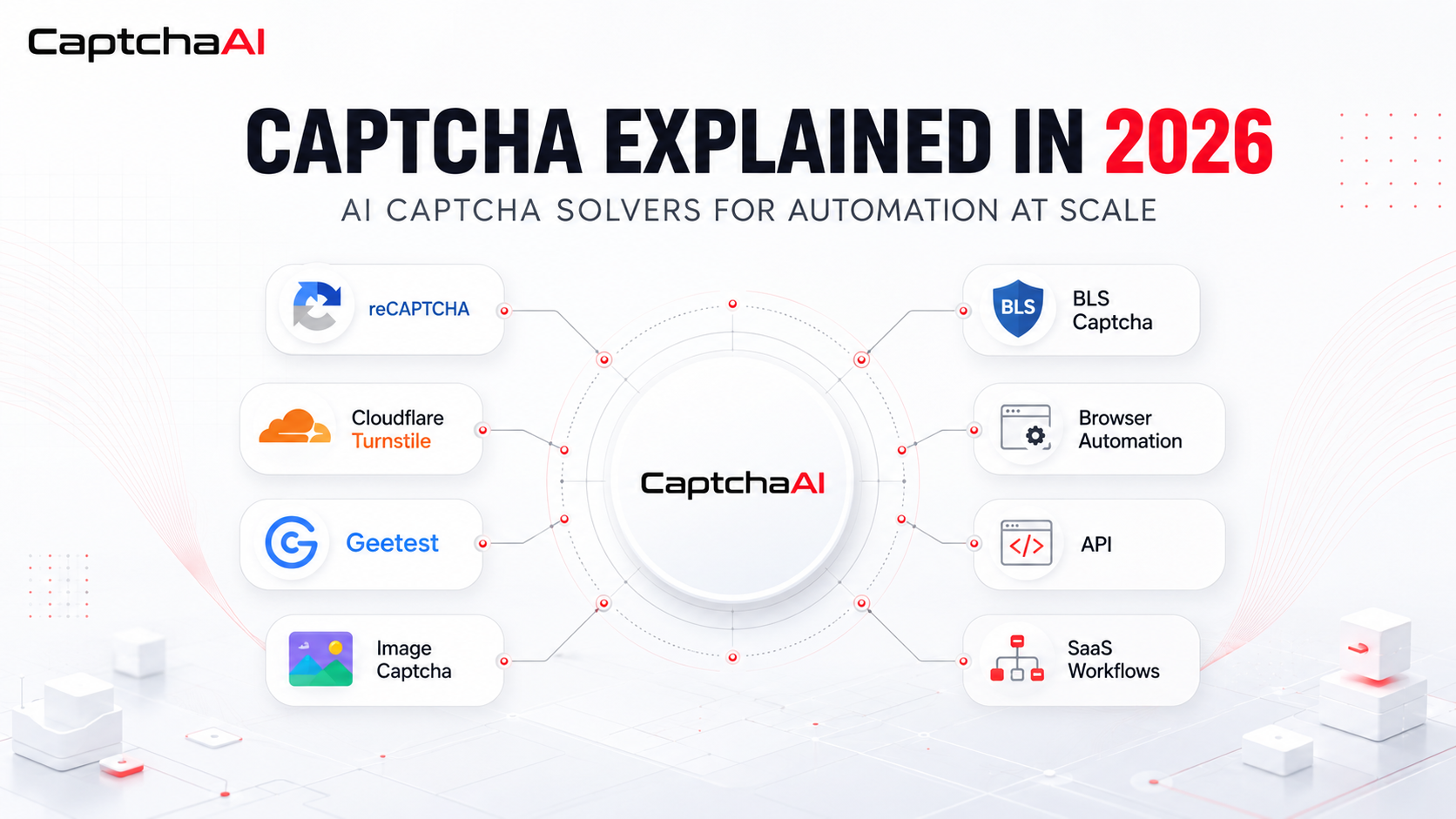
CAPTCHA is a major security layer on the modern web. Websites use it to reduce spam, protect forms, secure login pages, and limit abusive traffic. For developers and automation teams, it can become a serious bottleneck.
In 2026, automation supports web scraping, data collection, QA testing, SEO monitoring, browser workflows, and backend systems. These workflows need speed, consistency, and predictable cost. When CAPTCHA appears, it can stop requests, trigger retries, and reduce efficiency.
AI CAPTCHA solvers process challenges through AI-based recognition and challenge-specific workflows. CaptchaAI supports developers, scripts, browser automation, and high-volume workflows with wide CAPTCHA support, fast response times, API access, Chrome Extension support, and fixed monthly pricing.
What Is CAPTCHA?
CAPTCHA stands for Completely Automated Public Turing test to tell Computers and Humans Apart.
Early CAPTCHA systems were simple text puzzles. As OCR improved, providers developed advanced methods. Modern systems may use image recognition, behavior analysis, browser signals, risk scoring, device data, and session quality.
Common CAPTCHA Types in 2026
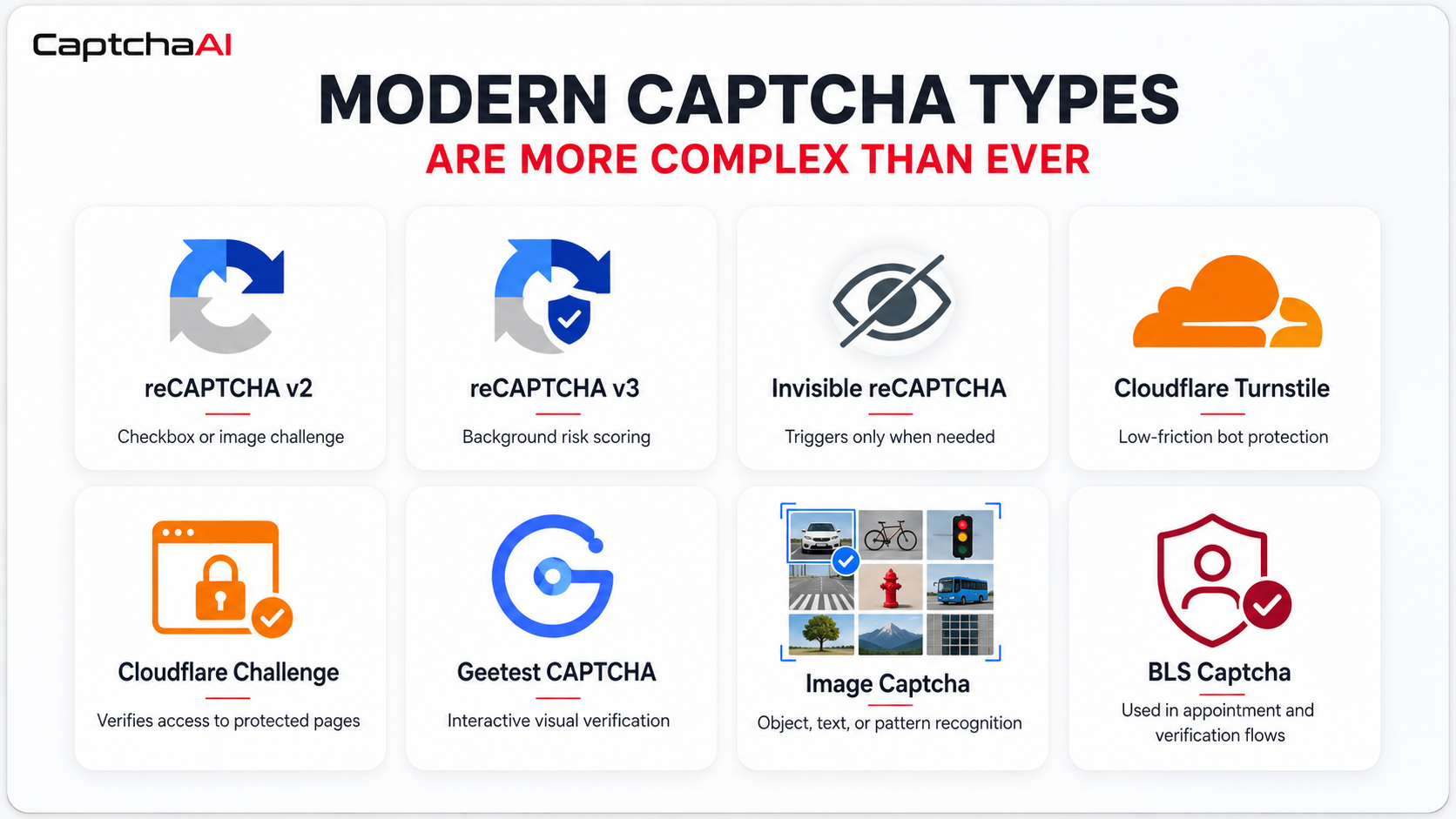
The CAPTCHA landscape is more complex than before. Google reCAPTCHA v2 appears as a checkbox or image challenge, where users identify objects in images.
Google reCAPTCHA v3 works in the background and assigns a risk score. Invisible reCAPTCHA reduces visible friction, but can still trigger a challenge. Cloudflare Turnstile provides low-friction verification. Cloudflare Challenge protects websites before access is allowed.
Geetest CAPTCHA often includes visual or interactive challenges. Image Captcha and Grid Image Captcha require users to recognize objects, text, patterns, or instructions. BLS CAPTCHA supports appointment and verification workflows. For automation teams, one CAPTCHA type is no longer enough.
Why CAPTCHA Breaks Automation Workflows
Automation works best when every step is predictable. A workflow opens a page, submits a request, collects a result, and moves to the next task. CAPTCHA interrupts that flow.
When CAPTCHA appears, the workflow may pause, fail, retry, or require manual work. More retries consume proxy bandwidth and compute resources. Failed requests reduce data quality.
What Is an AI CAPTCHA Solver?
An AI CAPTCHA solver uses artificial intelligence to process CAPTCHA challenges automatically. It may rely on computer vision, pattern recognition, image classification, machine learning models, and challenge-specific solving logic.
An automation system detects a CAPTCHA challenge. The challenge data is sent through an API, extension, or integration. The solver returns a result, and the workflow continues.
A strong AI CAPTCHA solver should provide fast response times, high success rates, wide coverage, stable performance, scalable concurrency, simple integration, and predictable pricing.
Why CaptchaAI Fits Automation at Scale
CaptchaAI supports Python scripts, Node.js applications, browser automation tools, SaaS systems, and custom backend workflows.
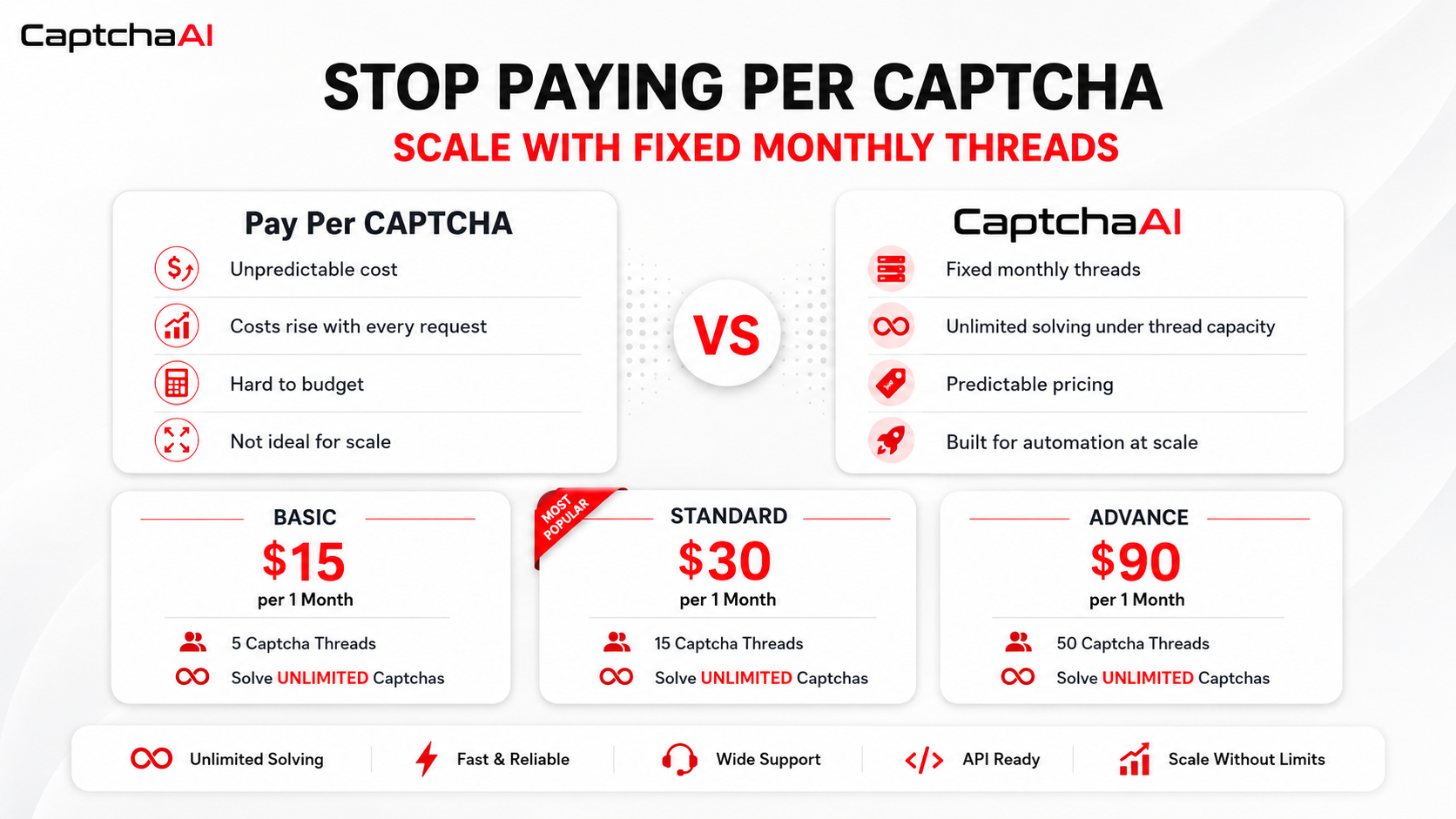
Its main advantage is pricing. Many traditional CAPTCHA services charge per request. CaptchaAI uses fixed monthly thread-based pricing instead. Users choose a plan based on threads, then solve unlimited CAPTCHAs under that plan’s thread capacity.
The first visible CaptchaAI plans are:
BASIC: $15 per 1 Month, 5 Captcha Threads, Solve UNLIMITED Captchas
STANDARD: $30 per 1 Month, 15 Captcha Threads, Solve UNLIMITED Captchas
ADVANCE: $90 per 1 Month, 50 Captcha Threads, Solve UNLIMITED Captchas
Threads represent parallel solving capacity. Five threads allow five CAPTCHA solving tasks at the same time.
Key CaptchaAI Features
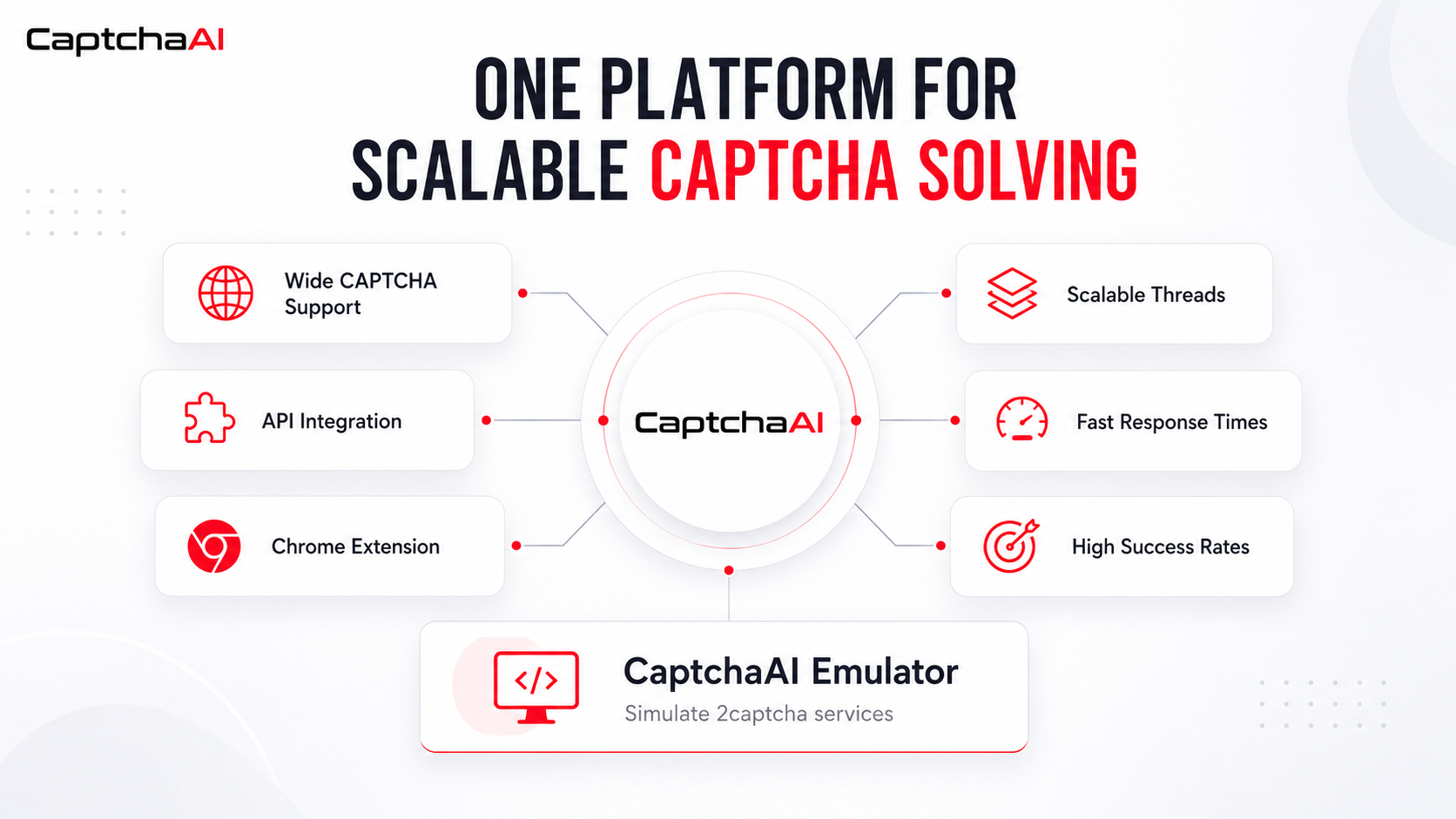
CaptchaAI supports Image Captcha, Grid Image Captcha, Google reCAPTCHA v2, Google reCAPTCHA v3, Invisible reCAPTCHA v2, reCAPTCHA Enterprise, Cloudflare Turnstile, Cloudflare Challenge, Geetest CAPTCHA, and BLS CAPTCHA.
This broad support helps automation teams avoid multiple providers. CaptchaAI is optimized for fast response times and stable solving performance. The service provides API integration for scripts, backend systems, browser automation frameworks, and SaaS workflows. CaptchaAI also provides a Chrome Extension.
CaptchaAI Emulator: Simulate 2captcha services.
CaptchaAI Use Cases
CaptchaAI is useful for web scraping, data collection, SEO monitoring, QA testing, browser automation, SaaS backend workflows, and data pipelines across modern workflows.
Why Fixed Monthly Threads Matter
Predictable pricing is one of the strongest reasons to use CaptchaAI. With pay-per-captcha services, costs rise with every request. CaptchaAI solves this with fixed monthly plans. Users pay for thread capacity, not every CAPTCHA request.
The strategy is simple: stop paying per CAPTCHA. Scale with unlimited solving and fixed monthly threads.
Community and Updates
Follow CaptchaAI community channels for updates, announcements, and new offers.
Check CaptchaAI community links on CaptchaAI website
Final Thoughts
CAPTCHA will continue to evolve as websites improve security and bot protection. Automation will remain essential for data collection, QA testing, SEO monitoring, SaaS workflows, and backend operations.
CaptchaAI combines broad CAPTCHA coverage, fast response times, high success rates, API support, Chrome Extension access, CaptchaAI Emulator, scalable threads, and fixed monthly pricing. With plans starting at $15 per 1 Month and unlimited solving under thread capacity, it is a strong choice for reliable CAPTCHA solving in 2026.
Ready to test with real IPs?
Register now to get immediate access to our proxy pools.